
Beyond the Headlines:
What the Stipelis Bond Market Index Indicator Is Telling Us Right Now!
One of the challenges of following financial markets is deciding what deserves our attention.
Every day brings a new headline. One day it’s the Federal Reserve. The next day it’s economic growth. Then earnings reports take center stage. Before long, geopolitical tensions dominate the news cycle.
The stories change constantly.
The broader market trends usually change much more slowly.
That distinction is one of the reasons I pay close attention to the Stipelis Bond Index Indicator.
The purpose of the indicator is not to predict the future. It does not attempt to forecast the next Federal Reserve decision, the next economic report, or the next geopolitical event.
Instead, it focuses on something simpler.
It seeks to identify whether momentum appears to be strengthening or weakening within the bond market and whether larger trends are becoming more favorable or less favorable over time.
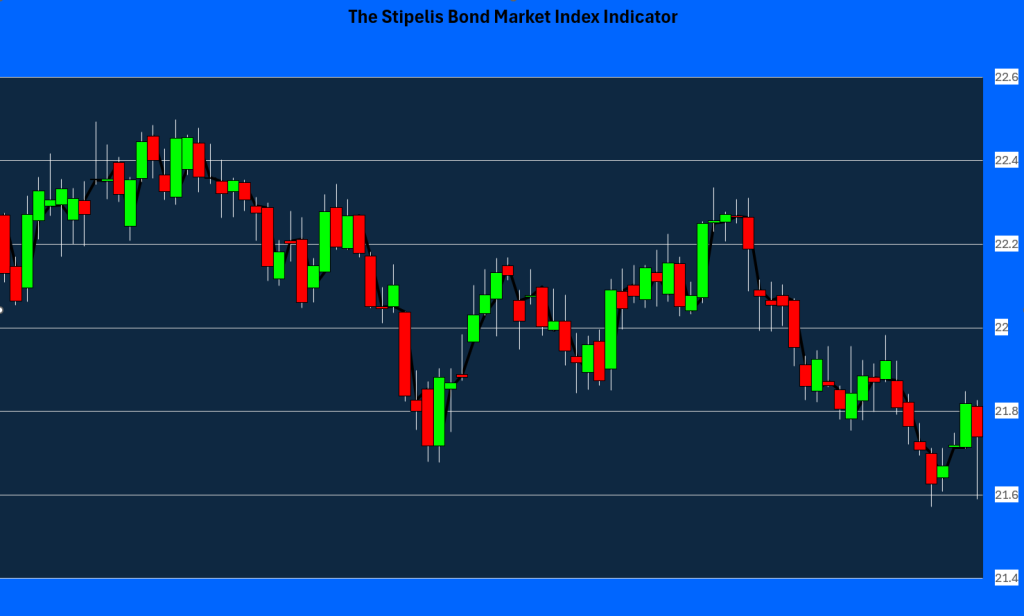
Right now, the Stipelis Bond Index Indicator continues to reflect a market that remains cautious.
The index is trading below its 20-day, 50-day, and 200-day moving averages. Momentum remains soft. Directional measures continue to favor downside pressure. At the same time, the bond market is approaching an area near its 52-week low, suggesting investors are evaluating whether current conditions justify further weakness or potential stabilization.
Viewed in isolation, those technical readings are informative.
Viewed against today’s major news developments, they become even more meaningful.
The Federal Reserve Remains a Central Story
The Federal Reserve’s latest policy decision remains one of the most important developments affecting financial markets.
Officials left interest rates unchanged, but inflation remains above the Fed’s long-term target, and policymakers continue to debate the appropriate path forward. Some central bank officials favored a more restrictive stance, highlighting the ongoing uncertainty surrounding inflation and economic conditions.
The Stipelis Bond Index appears to be reflecting that uncertainty.
If investors were completely comfortable that inflation was under control, bond prices would likely be showing more evidence of strength. Instead, the indicator continues to show a market that has not yet fully embraced a more optimistic view.
That does not necessarily mean investors expect worsening conditions.
It simply suggests that conviction remains limited.
Markets often spend long periods evaluating competing narratives before reaching a consensus.
At the moment, the bond market appears to be doing exactly that.
A Slower Economy Is Creating Mixed Signals
Today’s economic data added another layer of complexity.
The U.S. economy grew at an annual rate of 1.5% during the second quarter, down from 2.1% in the first quarter. Consumer spending remained reasonably strong, but overall growth moderated.
Under normal circumstances, slower growth might provide support for bonds because a cooling economy can reduce inflation pressures.
However, inflation has not completely disappeared from the conversation.
As a result, investors are facing two competing realities at the same time.
Growth is slowing.
Inflation remains elevated.
The Stipelis Bond Index appears to be reflecting that tension.
Rather than showing a decisive shift toward optimism or pessimism, the indicator continues to display a market searching for direction. The weakness in momentum suggests caution, while the proximity to longer-term support levels suggests investors are also looking for signs that conditions could stabilize.
In many ways, the current environment feels less like a turning point and more like a waiting period.
Corporate Earnings Continue to Paint an Uneven Picture
Another major story this week has been corporate earnings.
Some large companies have reported very strong results, while others have disappointed investors despite posting growth. The market’s reaction suggests that expectations remain exceptionally high and that investors are scrutinizing every detail.
This matters because corporate earnings provide insight into the broader economy.
When earnings are broadly strong, confidence in future economic activity generally improves.
When results are mixed, uncertainty often increases.
The current earnings season appears to fall into the second category.
There is strength in some areas of the economy and weakness in others.
The Stipelis Bond Index is not designed to evaluate individual companies. However, it does provide a useful way of monitoring how investors collectively respond to changing economic conditions.
So far, the indicator continues to suggest that investors remain cautious rather than enthusiastic.
The Iran Conflict Has Returned to the Front Page
Geopolitical developments have also become increasingly important.
Today brought significant news involving renewed military activity between the United States and Iran.
According to multiple reports, U.S. forces launched a new wave of strikes against Iranian military targets following attacks on U.S. military positions in the region. Additional reports indicate continuing missile activity, concerns over regional shipping routes, and growing fears that tensions could spread beyond their current boundaries.
For markets, the primary concern is not simply the conflict itself.
The larger concern is the potential impact on energy supplies, transportation routes, and global economic activity.
Reports continue to highlight risks surrounding the Strait of Hormuz, one of the world’s most important energy transit corridors. Any disruption to shipping activity in that region naturally attracts attention from investors around the world.
The Stipelis Bond Index cannot tell us how the conflict will develop.
No indicator can do that.
What it can do is help us observe whether investors are becoming more defensive or more confident as events unfold.
At the moment, the indicator continues to suggest caution rather than confidence.
That observation is consistent with the broader market environment, where uncertainty remains elevated and where investors continue to weigh a wide range of possible outcomes.
Global Central Banks Still Face Difficult Choices
While much of the attention remains focused on the Federal Reserve, central banks across the world continue to wrestle with similar challenges.
Japan, for example, remains an important market to watch. Policymakers there are balancing inflation concerns, economic growth, and interest-rate policy while investors assess the potential impact on global capital flows.
This may seem distant from U.S. markets, but today’s financial system is highly interconnected.
Decisions made in one part of the world often influence borrowing costs, currencies, and investment behavior elsewhere.
The Stipelis Bond Index helps cut through some of that complexity by focusing on observable market behavior rather than narratives.
Instead of asking what should happen, it asks a simpler question:
What appears to be happening?
At the moment, the answer remains fairly straightforward.
Momentum remains weak.
The longer-term trend remains under pressure.
Investors remain cautious.
What the Indicator Is Saying
Looking strictly at the technical picture, the Stipelis Bond Index currently reflects a market that remains challenged.
The index is trading below:
- The 20-day moving average
- The 50-day moving average (21.97)
- The 200-day moving average (22.44)
Momentum indicators such as RSI and Stochastic readings remain below neutral levels. Directional indicators continue to show greater downside pressure than upside pressure. Meanwhile, prices remain only slightly above the 52-week low of 21.57.
None of these observations guarantee future outcomes.
Markets change.
Conditions evolve.
New information emerges every day.
However, the collection of evidence currently suggests that investors remain cautious and that the bond market has not yet demonstrated a sustained shift toward stronger momentum.
Final Thoughts
One of the lessons learned from decades of observing markets is that headlines rarely tell the entire story.
Today’s headlines involve Federal Reserve policy, slower economic growth, corporate earnings, rising geopolitical tensions involving Iran, and continued uncertainty across global financial markets.
All of those developments matter.
But instead of focusing on individual headlines, the Stipelis Bond Index Indicator focuses on the market’s collective response to those developments.
Right now, that response appears cautious.
The longer-term trend remains under pressure. Momentum remains weak. Investors continue to evaluate competing forces including inflation, economic growth, monetary policy, and geopolitical risk.
Whether those conditions ultimately improve or worsen remains unknown.
What the indicator provides is context.
And in a world overflowing with headlines, context is often just as valuable as the news itself.
This commentary is provided for informational and educational purposes only. It reflects general observations regarding financial markets and current events and should not be construed as investment advice, a recommendation, or a solicitation to buy or sell any security, commodity interest, or other financial instrument. Past performance is not indicative of future results.
Further Reading: About Stipelis