
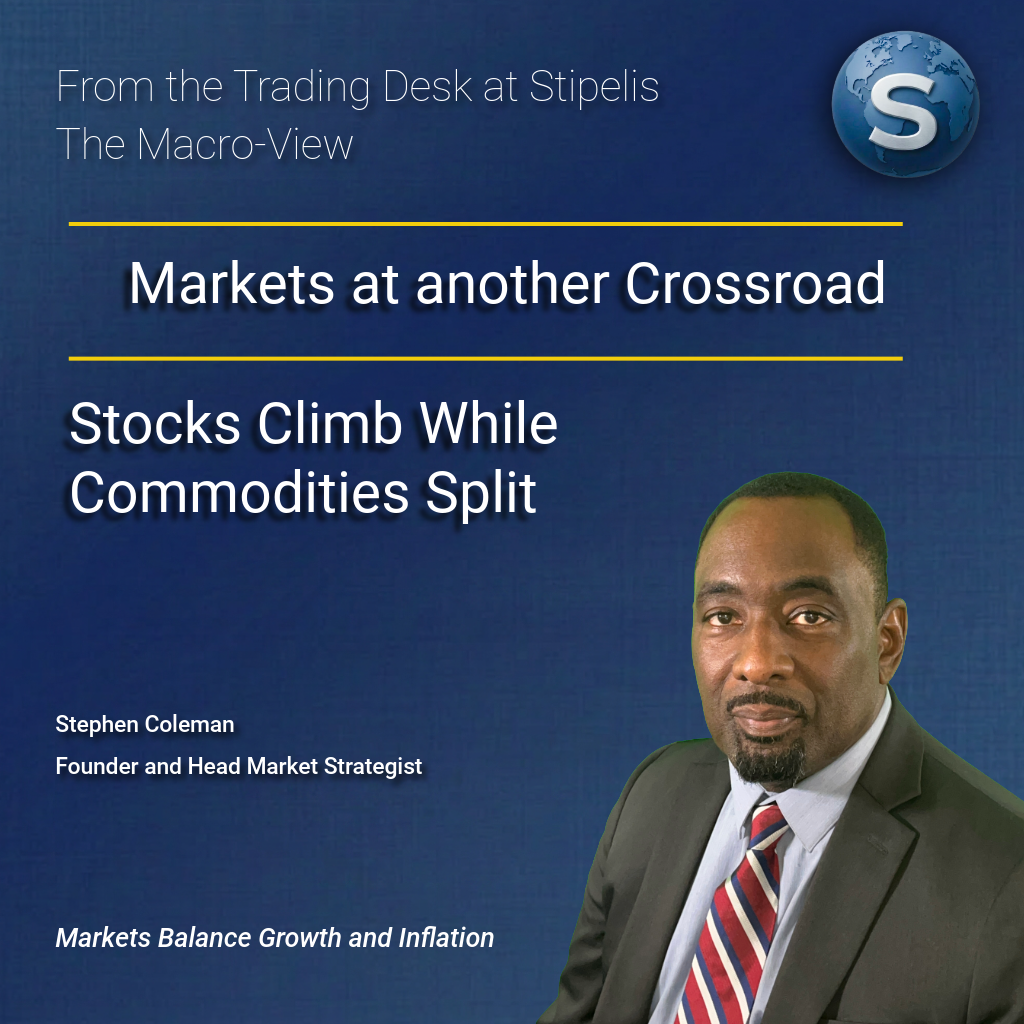
From the Trading Desk at Stipelis
The Macro View: Global Market Moves Across Asset Classes
Global markets are starting the week with a combination of signals that deserve attention. Stocks are advancing, bonds are improving, the U.S. dollar is strengthening, and commodity performance has become increasingly mixed. Taken individually, each of these developments tells part of the story. Viewed together, they provide a broader perspective on how investors are interpreting growth, inflation, interest rates, and geopolitical developments.
One of the clearest themes remains the strength of U.S. equities. Major stock indexes moved higher at the end of last week and have continued to build on those gains at the start of this week. Technology stocks remain at the center of that leadership. The Nasdaq continues to outperform many other major asset classes, extending a trend that has defined much of the year.
Technology leadership is important because it often reflects confidence in future earnings growth and business investment. Market participants appear willing to look beyond near-term concerns and focus on the ability of major companies to continue generating revenue and profits. This does not eliminate risk, but it does help explain why investors have remained engaged even while interest rates remain elevated.
The strength in equities becomes even more notable when viewed alongside Treasury yields. The 10-year Treasury yield remains above 5%, a level that historically created challenges for growth-oriented sectors. Instead of slowing equity enthusiasm, investors appear to be placing greater weight on economic resilience and corporate fundamentals.
Another important development is the continued decline in market volatility. The VIX remains near relatively subdued levels, reflecting reduced investor anxiety compared to previous periods of uncertainty. Lower volatility does not guarantee stable markets, but it often indicates that investors are more comfortable absorbing new information without making dramatic adjustments to risk exposure.
Bonds are also providing valuable insight into current market conditions. Treasury prices have shown improvement even as yields remain elevated. At first glance, this may appear contradictory. However, it suggests that investors are continuously reassessing future economic conditions and inflation expectations.
Inflation remains one of the most important themes influencing markets. Although inflation is no longer dominating headlines in the same way it did during earlier periods, it remains a critical variable for central banks, corporations, and investors. Energy costs, labor market conditions, consumer demand, and government policy all contribute to the inflation outlook.
Market participants appear increasingly focused not only on the current inflation rate but on whether inflation pressures are becoming less severe over time. Financial markets are forward-looking by nature. Investors often respond more to changes in expectations than to the latest reported data point.
This helps explain why bond markets and equity markets can sometimes strengthen simultaneously. If investors believe inflation pressures may gradually moderate while economic growth remains intact, both asset classes can find support.
The U.S. dollar remains another central part of the macroeconomic picture. Dollar strength continues to influence a wide range of markets. For international investors, a stronger dollar affects capital flows, trade competitiveness, and the purchasing power of foreign currencies.
Commodity markets often feel the effects of dollar movements. Since many commodities are priced in U.S. dollars, a stronger currency can create additional pressure on prices. Recent trading activity reflects this relationship, particularly within portions of the energy and agricultural sectors.
Commodity markets themselves continue to provide a diverse set of signals. Unlike equity indexes, commodity markets rarely move as a single group. Each market faces its own supply conditions, weather risks, transportation concerns, production trends, and demand patterns.
Agriculture demonstrates this reality clearly. Cotton has emerged as one of today’s strongest performers, benefiting from weather uncertainty and ongoing interest in export demand. At the same time, other agricultural products continue to face pressure from changing supply expectations and shifting market sentiment.
The sharp decline in lean hogs last week was particularly noteworthy. A move of that magnitude often reflects more than routine day-to-day volatility. It suggests market participants are reassessing supply-demand dynamics and adjusting valuations accordingly.
Cocoa also experienced significant weakness. After prior strength, improving crop expectations and profit-taking created substantial selling pressure. These types of moves serve as reminders that commodity markets frequently react to highly specific fundamental developments.
Energy markets have become one of the most closely watched sectors in the current environment. Crude oil experienced a sharp decline today despite ongoing geopolitical uncertainty. This move followed a period of strong performance and appears connected to profit-taking, changing demand expectations, and reduced concerns about immediate supply disruptions.
The decline in crude oil carries broader implications beyond the energy sector. Energy prices influence transportation costs, manufacturing expenses, consumer spending patterns, and inflation expectations. As a result, movements in oil often affect multiple asset classes simultaneously.
Lower energy prices can reduce concerns about inflation. When inflation concerns ease, bond markets often respond positively. Equity markets may also benefit if investors believe lower energy costs support economic activity. These relationships help explain why today’s weakness in energy has coincided with strength in several financial assets.
Yet energy remains closely tied to geopolitical developments. The situation involving Iran continues to serve as an important source of uncertainty. Market participants remain attentive to developments affecting oil production, transportation routes, and regional stability.
The impact of geopolitical risks can sometimes be difficult to measure because markets often price in expectations before events occur. Despite today’s weakness in oil, energy markets continue to reflect a degree of risk premium associated with geopolitical uncertainty.
This creates an interesting dynamic. Financial markets appear increasingly comfortable with the economic outlook, while geopolitical risks remain present in the background. Both realities can exist simultaneously.
Another theme emerging across markets is the divergence between financial assets and certain commodity sectors. Stocks have generally reflected confidence in economic growth, while many commodity markets have experienced weaker price action. Such divergences are often worth monitoring because they reveal differences in how various groups of market participants interpret economic conditions.
Cross-asset analysis becomes valuable during periods like this. Rather than focusing on a single market, it encourages observers to examine relationships between equities, bonds, commodities, currencies, and volatility measures.
For example, stronger stocks may signal confidence in future growth. Stronger bonds may reflect moderating inflation concerns. A stronger dollar may indicate continued international demand for U.S. assets. Lower volatility may suggest reduced market stress. Weak energy prices may point to changing views about inflation and demand.
No individual signal should be viewed in isolation. Markets function as an interconnected system where developments in one area often influence others.
Technology leadership continues to stand out within the equity landscape. Large technology companies remain among the strongest areas of the market, reinforcing the view that investors continue rewarding businesses associated with innovation and growth.
At the same time, traditional defensive positioning appears less prominent than during periods of heightened uncertainty. This shift helps explain why growth-oriented sectors have been able to outperform despite elevated interest rates.
From a macro perspective, the current environment resembles a river with several powerful currents moving in different directions. Economic growth remains supportive. Inflation concerns have not disappeared but appear more manageable than before. Bond markets are adapting to changing expectations. Commodity markets are sorting winners from losers. Geopolitical risks remain present but are not dominating investor behavior on a daily basis.
As the week progresses, markets will continue processing economic data, central bank communication, inflation trends, and global developments. The interaction among these factors will remain more important than any single headline.
For now, the broader picture suggests investors continue balancing optimism and caution. Financial assets are showing resilience, commodity performance remains uneven, and geopolitical developments continue to influence expectations.
Understanding these relationships helps provide context for what is occurring beneath the daily market headlines. Markets rarely move because of one factor alone. Instead, they reflect the interaction of countless decisions, expectations, and changing perceptions.
Today, those interactions reveal a market environment that remains dynamic, interconnected, and worthy of close observation.
Stephen Coleman
Head Market Strategist
Stipelis Global Trading LLC