
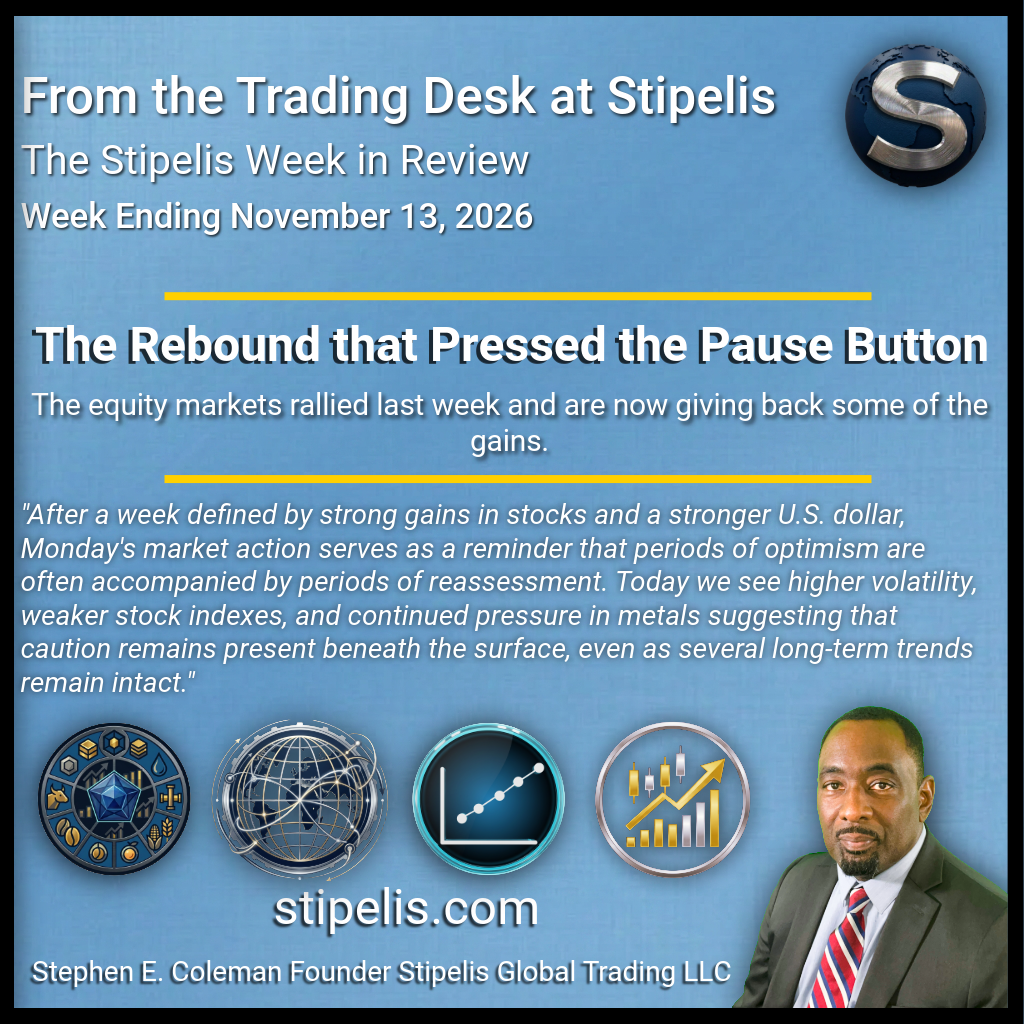
The Week in Review from The Trading Desk at Stipelis
Last week was largely defined by confidence returning to financial markets. Stock index futures pushed higher, volatility fell sharply, and several agricultural markets quietly strengthened. By Monday, however, the tone had shifted. Equity markets pulled back, volatility rebounded, and investors appeared more cautious than they were just a few trading sessions earlier.
Taken together, last week and Monday’s session offered a useful reminder that markets can change character quickly.
The strongest area of the market last week was the equity sector. Nasdaq 100 futures gained 3.51%, leading the major indexes. The S&P 500 added 2.45%, while the Dow Jones Industrial Average advanced 2.01%. Small-cap stocks also participated, with Russell 2000 futures gaining 1.34%.
The strength of these markets reflected a generally favorable environment for risk assets during most of the week. Falling volatility helped support that sentiment. The VIX declined nearly 25% and the VVIX fell almost 17%, suggesting that concerns about near-term market fluctuations eased considerably as the week progressed.
One of the more notable confirmations of this strength came from the Stipelis Equity Index (SGTEQ), which gained 2.27% during the period. Its performance aligned with the broader advance across stock index futures and reflected the generally constructive tone seen in equities.
Monday, however, told a different story.
Nasdaq 100 futures declined more than 2% intraday. S&P 500 futures fell roughly 1.5%, while Dow futures lost nearly 1%. None of these moves erased last week’s gains, but they did interrupt the strong upward momentum that had been established over the previous several sessions.
At the same time, volatility moved in the opposite direction. The VIX rose more than 11% during Monday’s trading session. After spending the previous week declining, volatility suddenly returned to market conversations.
This change in tone does not necessarily alter the broader trends that have developed during the year. The S&P 500 remains more than 10% above where it began the year, while the Nasdaq 100 has gained just over 10% on a year-to-date basis. Even so, Monday demonstrated that market advances rarely occur without interruptions.
Beyond stocks, perhaps the most important market theme was the continued strength of the U.S. dollar.
The Dollar Index gained 1.12% during the week and continued climbing Monday, reaching a fresh four-week high. Dollar strength was one of the most consistent themes across both periods.
As the dollar strengthened, several major foreign currencies moved lower. The euro lost 1.07% for the week. The British pound declined 1.06%. The Australian dollar fell 1.29%, while the Swiss franc posted the largest decline, dropping 2.33%.
Currency markets often influence many other areas of the investment landscape. During the past week, the stronger dollar coincided with weakness in several commodity markets, particularly precious metals.
Gold futures declined 4.63% during the week, while silver fell 5.43%. Copper also weakened, losing 2.36%.
The pressure did not stop when the calendar turned to Monday.
Silver became one of the weakest markets on the board, falling another 4.12% and breaking to a new four-week low. Gold managed a more contained decline, down roughly 0.4% during Monday’s session, but remained well below recent highs.
One Stipelis indicator highlighted this weakness clearly. The Stipelis Metals Tracker (SGTMT) fell 4.20% during the week. The indicator reflected what was happening across multiple metal markets rather than a decline in just one contract.
The contrast between stocks and metals was one of the most striking stories of the week. While equity markets generally moved higher, metals moved sharply lower.
Interest rate markets also experienced a challenging week.
Ten-Year Note futures declined 1.79%, while Thirty-Year Bond futures lost more than 3%. Additional weakness was seen across shorter-duration Treasury contracts as well.
These moves occurred during a period when stock markets were strengthening and the dollar was advancing. Both developments contributed to a market environment that looked very different from what investors experienced earlier in the year.
Monday brought a modest recovery in the Ten-Year Note market, which gained about 0.13%. While the move was relatively small, it stood out because it contrasted with the broader weakness seen throughout the previous week.
Energy markets presented a mixed picture.
Crude oil declined 2.50% during the week. Gasoline futures fell 5.59%, while heating oil lost 1.69%.
Monday brought another round of selling pressure to crude oil. Prices fell approximately 2.7% during the session, making crude one of the weaker major markets at the start of the week.
Despite the recent pullback, crude oil remains substantially higher than where it began 2026. On a year-to-date basis, crude oil has risen more than 54%, making it one of the stronger long-term performers despite current weakness.
Natural gas told a very different story.
The market gained 7.74% during the week, making it one of the strongest commodity performers. Interestingly, natural gas was also listed as Friday’s largest daily loser, reminding us that short-term moves and weekly trends do not always point in the same direction.
The agricultural markets quietly produced one of the most constructive stories of the week.
Soybeans gained 3.16%. Soybean meal rose 3.32%. Soybean oil added 2.43%. Corn gained 0.91%, while wheat posted modest strength and finished Friday as the strongest daily performer among the major grain markets.
Agricultural strength continued into Monday.
Soybean meal appeared as the strongest bullish mover of the day, rising 1.21%. In a session where many stock indexes, metals, and energy products were under pressure, soybean meal stood out as one of the few markets showing notable strength.
The Stipelis Agriculture Index (SGTAGS) reflected this trend, gaining 1.61% for the week.
Livestock markets also contributed to the positive agricultural picture. Feeder cattle rose 5.18%, making it one of the strongest weekly performers across all futures markets. Lean hogs gained 3.60%, while live cattle advanced 3.08%.
Outside the traditional commodity sectors, Bitcoin futures experienced significant weakness. Bitcoin declined more than 9% during the week, making it one of the largest percentage losers in the data set provided.
Another noteworthy development came from transportation activity. The Baltic Dry Index gained 6.24% during the week, suggesting increased activity in global shipping markets. While no single indicator should be viewed in isolation, changes in shipping activity often provide useful context about economic conditions and trade flows.
Credit conditions also improved modestly. High-yield credit spreads narrowed during the week, which generally coincided with the stronger performance seen in equities and the decline in volatility.
Taken together, the market environment last week reflected improving confidence across many financial assets, even as commodity markets produced a more mixed picture.
That backdrop changed somewhat Monday.
Stocks turned lower.
Volatility moved higher.
Silver broke to a new four-week low.
Crude oil extended its decline.
The dollar continued making new short-term highs.
At the same time, some areas continued demonstrating relative strength. Soybean meal advanced, Treasury notes stabilized, and agricultural markets remained one of the brighter spots within the broader futures landscape.
As we begin the new week, the transition from last week’s optimism to Monday’s caution may become one of the more interesting developments to follow. The objective is not to predict what happens next, but rather to observe which themes are continuing and which themes are changing.
For now, the clearest ongoing themes appear to be dollar strength, weakness in metals, resilience in agriculture, and a stock market that remains higher on a weekly basis despite Monday’s setback.
Those themes helped define last week’s market action. Monday added a new layer to the story by showing that market leadership can shift quickly and that periods of strength are often followed by periods of reevaluation.
For observers of the futures markets, the week offered an important reminder. Markets do not all move together. While stocks climbed, metals fell. While agriculture strengthened, crude oil weakened. While volatility collapsed last week, it rebounded Monday.
Understanding those differences often provides a clearer picture than focusing on any single market alone.
Stephen Coleman
Founder and Registered Commodity Trading Advisor