
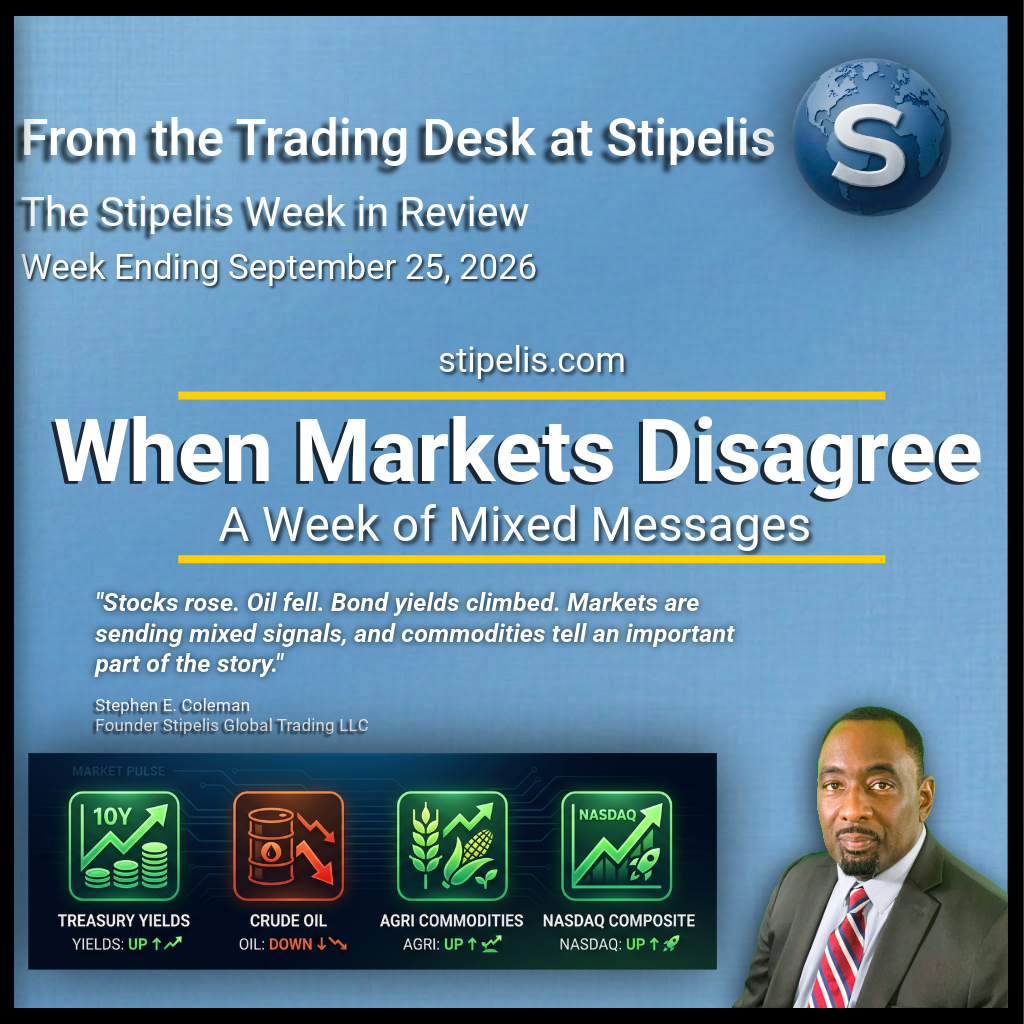
The Stipelis Week in Review
Week Ending September 25, 2026
A Week of Mixed Messages
If there was one word to describe this week, it would be contrast.
Stocks generally moved higher. The Nasdaq gained more than 3% while the S&P 500 posted another positive week. At the same time, Treasury bond prices moved lower as yields pushed higher. Energy markets experienced a sharp decline, while natural gas moved strongly in the opposite direction. Agricultural commodities were mixed but showed signs of resilience beneath the surface.
That combination tells an important story. Markets were not moving because of one simple theme. Instead, investors were responding to several competing forces at once. Economic growth still appears to be holding up. Inflation remains a concern. Interest rates continue to attract attention. Energy markets are adjusting to changing expectations. And agricultural markets are responding to their own set of supply and demand factors.
When several forces pull markets in different directions at the same time, understanding relationships becomes more important than focusing on a single headline.
That is where commodity-focused analysis can provide a broader view.
The Biggest Development: Higher Yields Continue to Matter
The biggest story this week was the continued rise in Treasury yields.
Longer-term Treasury bond prices fell sharply again. The 30-year Treasury futures contract declined more than 2% during the week. The 10-year note also moved lower. These moves reflect a market that continues to reassess the path of interest rates, inflation, and economic growth.
Meanwhile, stocks largely looked past those concerns.
Historically, rising yields and rising stock prices do not always move together comfortably for long periods. Yet that was the story this week. Investors appeared willing to focus on economic resilience while simultaneously adjusting to the reality of higher borrowing costs.
From a market observation standpoint, this matters because interest rates influence nearly every part of the economy. They affect consumers, businesses, real estate, lending activity, and investment decisions.
At Stipelis, our Bond Indicator declined 1.46% during the week, reflecting the pressure seen throughout fixed-income markets. The move was not dramatic because of a single event. Instead, it appears to be part of a broader adjustment that has been developing for months.
The message from bonds remains different from the message coming from stocks, and that difference deserves attention.
Energy Hits the Brakes
One of the largest moves of the week occurred in energy.
Crude oil fell nearly 8%. Gasoline futures dropped more than 9%. Heating oil also declined significantly.
Those are large weekly moves for markets that often influence transportation costs, manufacturing activity, and consumer spending.
At the same time, natural gas surged more than 10%.
That divergence is important because many people casually refer to “energy” as if it were one market. It is not. Different energy products respond to different drivers.
At Stipelis, our Energy Indicator fell 4.86%, making it one of the weakest areas we track this week.
For market observers, the decline in crude oil helped ease some concerns surrounding fuel costs. Yet natural gas strength reminded us that supply, weather expectations, and infrastructure issues can create very different outcomes across energy markets.
This week served as another example of why looking beyond a single benchmark can be helpful.
Agriculture Quietly Builds Strength
While much of the financial media focused on stocks and interest rates, several agricultural markets had a constructive week.
Soybeans gained 1.27%. Soybean meal rose more than 3%. Cotton advanced nearly 2%. Sugar climbed almost 7%. Cocoa gained more than 5%.
Not every agricultural market participated, but enough strength appeared across the sector to lift the Stipelis Agriculture Indicator by 1.58%.
These moves matter because agriculture directly affects global food production, transportation networks, consumer pricing, and international trade flows.
Agriculture rarely receives the same attention as technology stocks, yet the products produced by farmers touch virtually every household every day.
One reason commodities matter is that they often reveal changes occurring throughout the real economy before those changes become obvious elsewhere. Whether it is food, fuel, metals, or shipping activity, commodities tell the story of what people are producing, consuming, and transporting.
That broader perspective remains central to the way Stipelis evaluates markets.
Why Commodities Still Matter
Many investors spend most of their time watching stock indexes.
There is nothing wrong with that. Stocks are important.
But the global economy runs on physical goods.
Copper helps build infrastructure. Oil fuels transportation. Wheat feeds populations. Natural gas powers homes and industry. Cotton becomes clothing. Lumber becomes housing.
This week offered a perfect reminder.
Copper gained more than 1%. Natural gas jumped over 10%. Sugar rose nearly 7%. Cocoa gained over 5%. Shipping activity, as measured by the Baltic Index, increased more than 3%.
Those are not isolated statistics. Together they provide clues about activity occurring throughout the global economy.
At Stipelis, we monitor commodities because they provide information that cannot always be found in stock indexes alone. Our proprietary indicators are designed to track trends and relationships across multiple sectors, helping create a more complete view of what markets are communicating.
No single market tells the entire story.
The goal is to listen to all of them.
Looking Ahead
Several important reports are scheduled for next week.
Markets will receive updates on consumer confidence, employment trends, income and spending patterns, inflation, manufacturing activity, and weekly energy inventories.
Particular attention will likely be directed toward the Personal Consumption Expenditures inflation report and the September employment report.
Both releases may influence discussions surrounding economic growth, inflation pressures, and interest rates.
As always, the numbers themselves matter. Equally important will be how markets respond to those numbers.
That response often reveals more than the headline.
For now, the week closes with stocks showing resilience, energy markets retreating, agriculture strengthening in selected areas, and bond markets continuing to adjust to a higher-yield environment.
Different parts of the market are telling different stories.
That is exactly why we continue to watch all of them.
Watch List: Three Markets Deserving Attention
1. Treasury Bonds
Rising yields remain one of the most influential forces across financial markets.
2. Natural Gas
A gain of more than 10% this week makes natural gas one of the strongest movers on the board.
3. Agricultural Commodities
Strength in sugar, cocoa, soybean meal, and cotton suggests improving momentum in parts of the agricultural complex.
Managed Futures Perspective
This week’s market action highlighted why diversification matters. Strength appeared in some stock indexes, weakness emerged in energy and bonds, while selected agricultural markets moved higher. Trend-following approaches are designed to evaluate opportunities across many sectors rather than relying on a single market theme. Periods like this demonstrate how different asset classes can travel very different paths at the same time.
Looking Ahead
- Consumer Confidence
- ADP Employment Report
- GDP Revision
- Personal Income & Spending
- PCE Inflation Data
- Weekly Petroleum Report
- Initial Jobless Claims
- September Employment Report
- Nike Earnings
- Micron Earnings
- CarMax Earnings
The Trading Desk at Stipelis