
The Week in Review from the Trading Desk at Stipelis
Friday, October 9, 2026
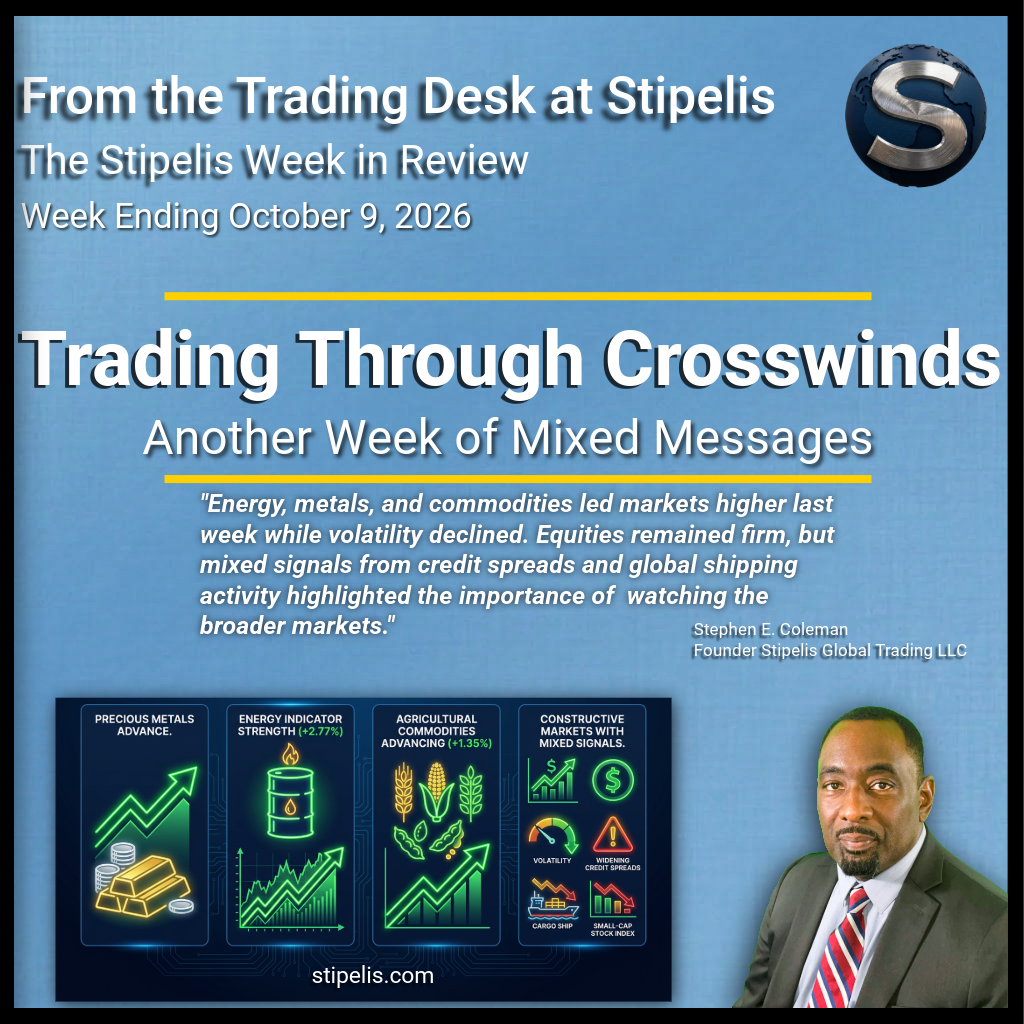
The dominant theme this week was the continued strength across commodity markets. While investors often focus primarily on stocks, some of the most notable moves occurred in energy, metals, and select agricultural markets. Natural gas rallied 6.1%, heating oil climbed 5.27%, copper advanced 2.18%, and gold reached another strong weekly gain of 1.30%.
These moves helped push the Stipelis Commodity Indicator (SGTCMI) higher by 1.35%, while the Stipelis Energy Indicator (SGTENG) posted the largest increase among all major Stipelis indicators, advancing 2.77%.
The broad participation across commodity sectors suggests the week’s story was not driven by a single market. Instead, strength appeared across industrial inputs, precious metals, and parts of the agricultural complex. When several commodity sectors begin moving together, it often reflects developments occurring throughout the broader economy rather than isolated supply and demand events.
Markets at a Glance
Equities
Large-cap equities remained constructive during the week.
S&P 500 futures (ES): +1.06%
Dow futures (YM): +0.87%
Nasdaq futures (NQ): +0.15%
The notable exception was Russell 2000 futures (RTY), which declined 1.01%.
This divergence suggests institutional money continued favoring larger capitalization companies while showing less enthusiasm for smaller firms.
The Stipelis Equity Indicator (SGTEQ) rose 0.61%, reflecting overall positive equity performance.
Fixed Income
Treasury markets posted modest gains.
30-Year Bond Futures (ZB): +0.26%
10-Year Note Futures (ZN): +0.22%
5-Year Notes (ZF): +0.15%
2-Year Notes (ZT): +0.07%
Meanwhile, SOFR futures were unchanged.
The Stipelis Bond Indicator (SGTBI) increased 0.22%, indicating relatively stable fixed-income conditions.
Currency Markets
The U.S. Dollar Index (DX) rose 0.30%.
Notable currency moves included:
Australian Dollar: +0.48%
Euro: -0.47%
Swiss Franc: -0.21%
Japanese Yen: lower on the week
The Stipelis Forex Indicator (SGTFX) slipped 0.10%, reflecting broadly mixed global currency performance.
Metals
Metals were among the strongest performers.
Copper: +2.18%
Gold: +1.30%
Silver: +1.05%
The Stipelis Metals Indicator (SGTMT) advanced 1.47%.
Copper’s strength continues to attract attention because of its connection to manufacturing, construction, infrastructure development, and electrification trends worldwide.
Energy
Energy led nearly every major asset class.
Natural Gas: +6.10%
Heating Oil: +5.27%
Crude Oil: +0.81%
RBOB Gasoline: -0.52%
The Stipelis Energy Indicator (SGTENG) climbed 2.77%, the strongest gain among the firm’s primary indicators.
Agriculture
Agricultural performance was mixed.
Gainers:
Soybean Meal: +5.21%
Cotton: +2.10%
Sugar: +1.61%
Soybeans: +1.08%
Decliners:
Corn: -3.62%
Wheat: -1.76%
Coffee: -0.62%
The Stipelis Agriculture Indicator (SGTAGS) increased 0.67%.
Alternative Assets
Bitcoin fell 2.51%, underperforming most traditional asset classes during the week.
Trend Watch
1. Energy Continues To Lead
The strongest theme this week remained energy.
Natural gas and heating oil posted impressive gains while crude oil continued moving higher. Energy often influences transportation costs, industrial activity, and household spending, making it one of the most economically significant sectors to monitor.
The continued leadership from the Stipelis Energy Indicator highlights the importance of watching energy markets alongside stocks and bonds.
2. Metals Maintain Momentum
Copper, gold, and silver all advanced during the week.
Gold’s strength suggests investors remain interested in traditional stores of value, while copper’s gains point toward continued attention on industrial demand and infrastructure trends.
The rise in the Stipelis Metals Indicator provides further confirmation that metals remain one of the strongest commodity groups currently being monitored.
3. Divergence Within Equities
At first glance, equities appeared strong.
However, the week’s details tell a more nuanced story.
Large-cap indexes finished higher while the Russell 2000 declined more than 1%.
When different segments of the stock market move in opposite directions, it often provides additional information beyond headline index performance. Market observers frequently monitor these relationships for clues regarding overall market participation and leadership.
Managed Futures Perspective
One of the most important lessons from this week is why broad market observation matters.
An investor focusing only on stock indexes would likely conclude that it was a relatively quiet week. Yet significant developments occurred elsewhere. Energy markets surged. Metals strengthened. Agricultural markets produced notable winners and losers. Currency markets shifted. Credit spreads widened modestly.
The Stipelis framework emphasizes monitoring multiple asset classes because economic developments rarely appear in only one market.
For example:
Rising energy prices may influence transportation and production costs.
Strong metals markets can reflect changes in industrial demand.
Currency movements affect global trade competitiveness.
Bond markets often respond differently than equities.
Agricultural markets provide insight into food and commodity supply conditions.
Several Stipelis indicators moved higher this week:
Indicator Weekly Change
SGTENG +2.77%
SGTMT +1.47%
SGTCMI +1.35%
SGTAGS +0.67%
SGTEQ +0.61%
SGTBI +0.22%
SGTFX -0.10%
Taken together, these results reflect broad participation across multiple commodity-related sectors while maintaining generally positive conditions in equities and fixed income.
At the same time, not every signal was positive. High-yield credit spreads widened slightly, and the Baltic Dry Index declined 7.34%, indicating that some areas of the global economy continue to send mixed messages.
This combination of confirming and conflicting signals illustrates why disciplined market observation remains essential. The goal is not to predict markets with certainty but to understand the information markets are providing in real time.
Looking Ahead
Investors will be monitoring several key themes in the upcoming week:
Inflation-related economic releases
Labor market updates
Treasury market developments
Energy market price activity
Currency fluctuations and U.S. dollar strength
Corporate earnings announcements
Commodity supply and demand developments
Ongoing movements in credit spreads
Particular attention may remain focused on whether strength in energy and metals continues and whether small-cap equities begin to participate more broadly alongside large-cap indexes.
Founder, Stephen Coleman